
• Menu
  • Skip to primary navigation
  • Skip to main content

Jennifer Luzzatto

Chartered Financial Analyst, Speaker & Author.

Header Left

  • Facebook
  • LinkedIn
  • YouTube

Header Right

SCHEDULE NOW
  • Home
  • About
  • The Book
  • Press
  • Contact
    • FAQ
  • Blog
  • Home
  • About
  • The Book
  • Press
  • Contact
    • FAQ
  • Blog

Investments

Navigating Market Volatility: A Long-Term Perspective on Investing

March 7, 2025 //  by Jennifer Luzzatto, CFA, CFP®, AIF®, CeFT®

We have had a few conversations with clients lately about what is happening in the US and the world from both an economic and geopolitical perspective.  There is a lot happening in fairly rapid succession, some of which are causing the equity markets to become more volatile.  While everyone likes volatility on the upside, no one enjoys the downside of volatility.  I want to try to address some of your potential concerns by pointing you to a broader, longer-term look at investing.


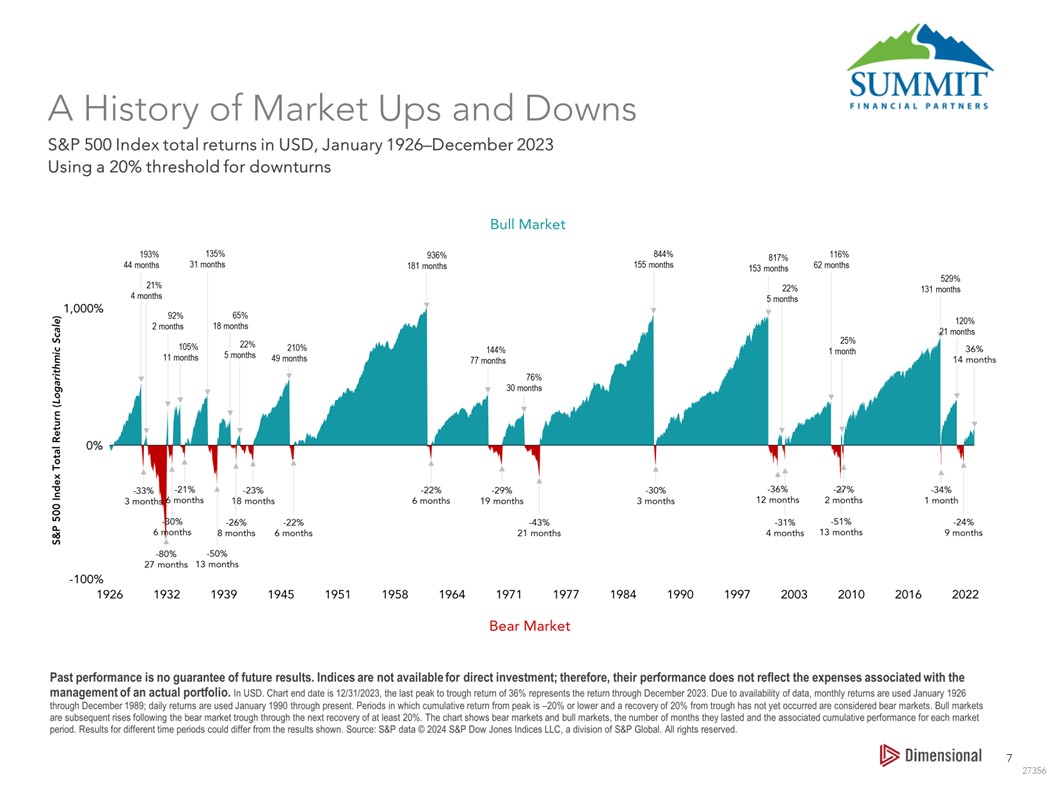
A History of Market Ups and Downs

First, let’s take a look at the historical performance of the S&P 500 since 1926, when the index first came into existence.  As you can see, the markets are positive much more frequently and for longer periods of time than they are negative.  Even the terrible Dot.com and Financial crisis look miniscule compared to the recoveries that happened afterwards.  As I am sure you recall, those were both pretty terrible times where the economy was in shambles and people were losing their homes.  Both periods were rough, with the Financial crisis of 2007-2009 being especially bad.    
 

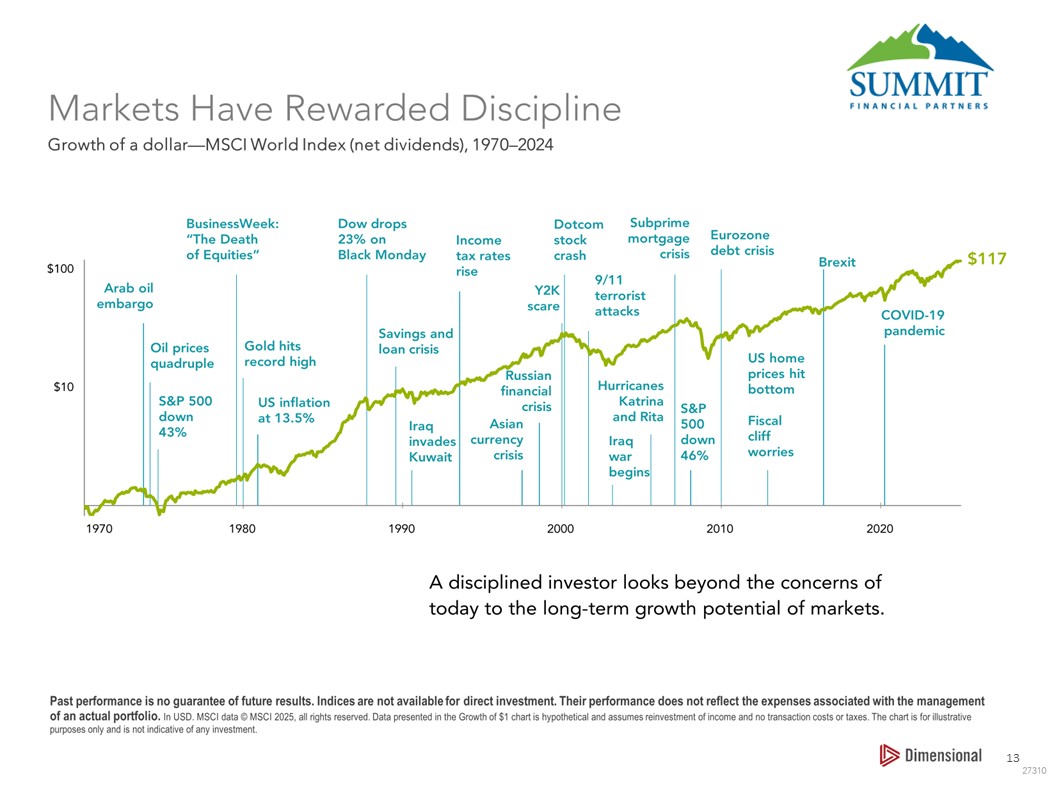
Markets Have Rewarded Discipline

Next, I want to address not only the long-term trend toward positive markets but also the comment we hear so often, “It is Different This Time.”  This chart shows some of the great challenges that have happened over the last 50 years.  And yes, each crisis was different, so the thought that “It is Different This Time” holds a lot of truth.  However, through each challenge the market has either not had a downturn or recovered from a correction in a relatively short period of time.  We have been through a lot in our lifetimes!  What ultimately drives stock market performance in the long term, though, is whether companies are profitable.  As long as the consumer continues to purchase and companies are well managed, stock prices will continue their upward trajectory.  Unfortunately, it is not a straight line up, and at times we have to endure some “zags” with the “zigs.”
 

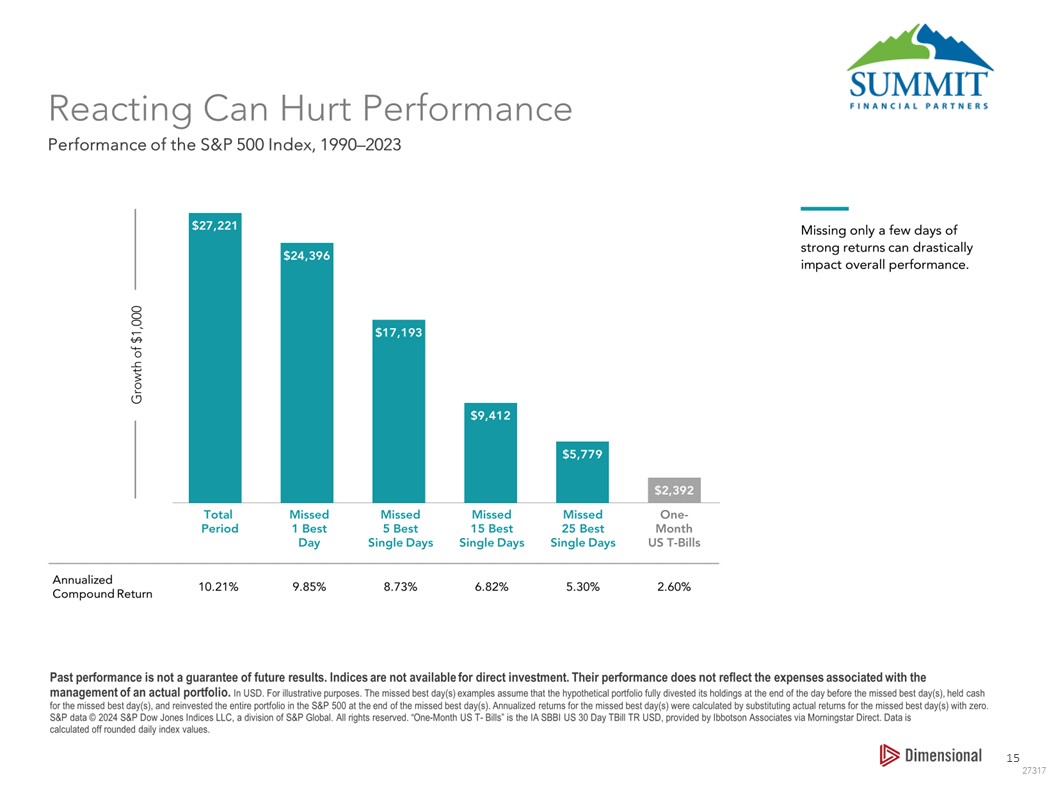
Reacting Can Hurt Performance

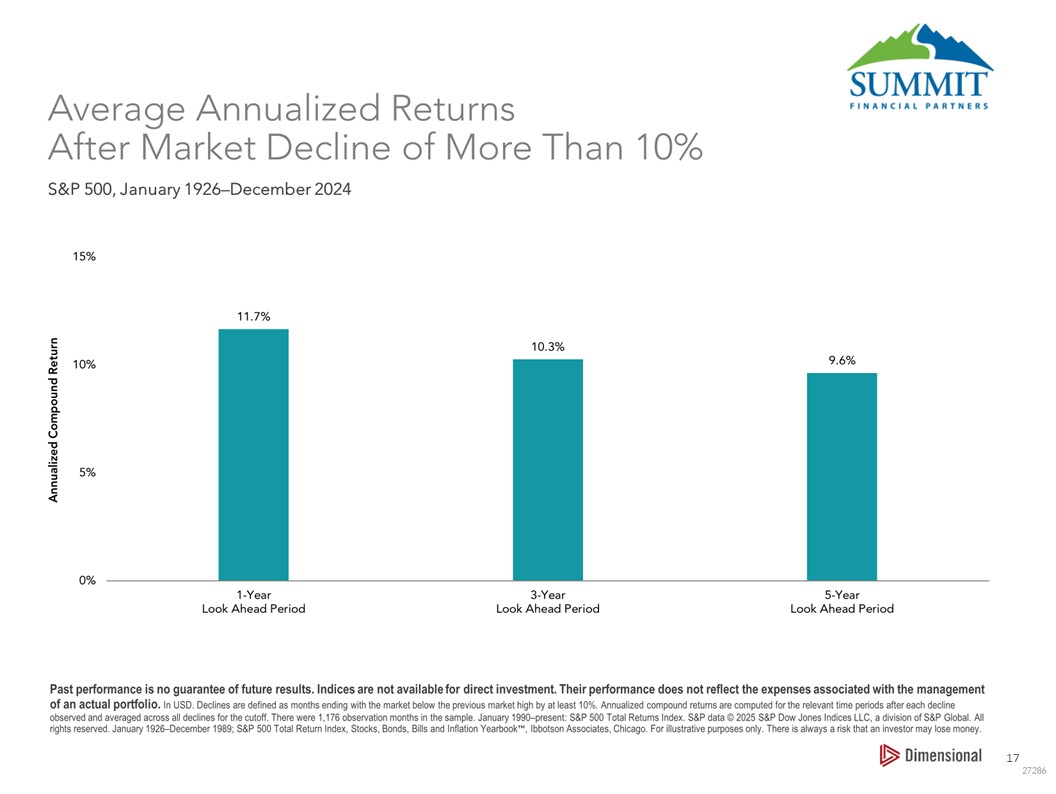
These last three graphs address the thought that many have of, “I have to do something!”  Our brains are wired to react when something unsettling is taking place.  It is part of the fight or flight phenomenon that happens in our amygdala.  It is our body’s way of helping us stay safe.  However, this reaction works against us when it comes to investing.  Getting out of the stock markets often seems like the right move.  Who wants to ride prices downwards?  I don’t really enjoy it either, but there is risk in that move.  Missing just a few of the best days of return can have huge consequences, as you can see the impact of missing the best days of returns over 25 years had on performance.  Who would think that missing 25 days could reduce your return from 10.21% to 5.3%?  That is enough to impact one’s standard of living.
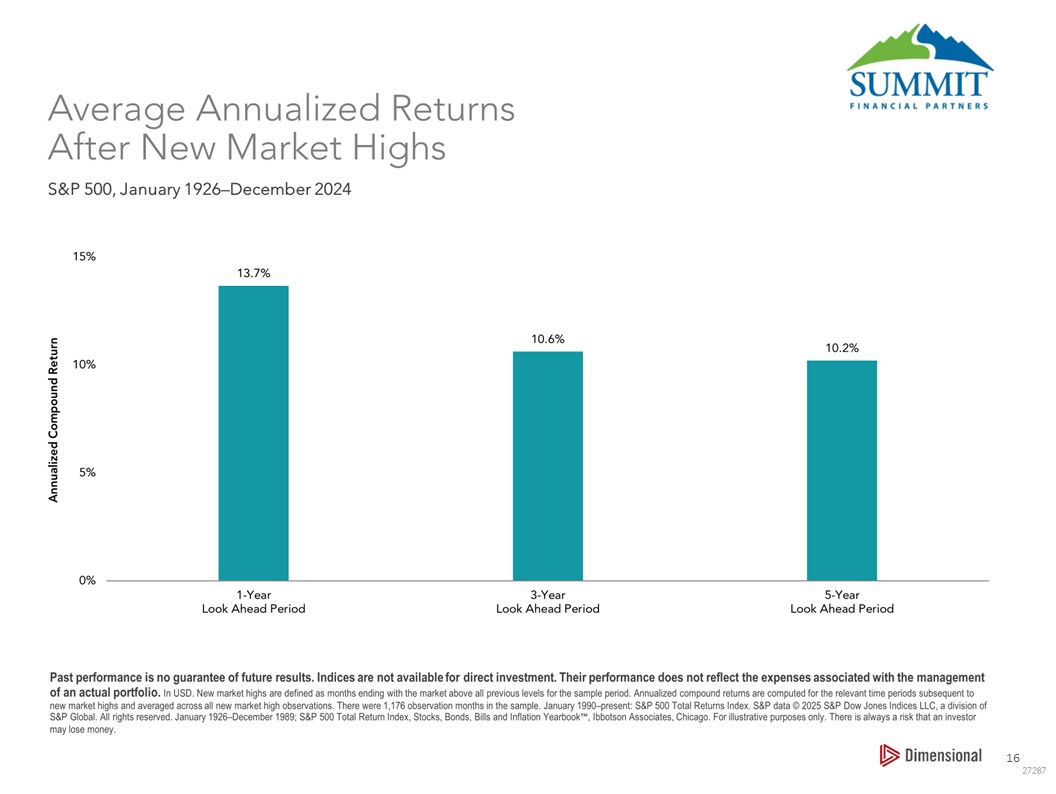
Humans also experience what is called “Recency Bias.”  Recency Bias is when we expect whatever has happened recently will continue going forward.  With investing it is assuming a negative market will not recover, at least not for a long, long time.  We experience the flip side of that thought with positive markets, and that is when investors tend to get overconfident and take on risks they would not normally accept. The below graphs, though, show that positive markets tend to happen in the long run, no matter what we are currently experiencing.
 

Tariff Concerns

One concern that I do not have a graph for is tariffs.  I share your concern that tariffs are a mighty big stick that is being used. Tariffs are a common tool for countries to use, but usually they are very stable.  I am confident that the markets will adjust to the eventual settling down of tariffs, but we are likely going to have to endure some more volatility until that happens.  The fact that companies exist to make profits and they are run by smart men and women gives me confidence that this landscape will eventually be navigated as well.
Dimensional recently held a live webcast on tariffs, Talking Top Stocks, Tariffs, and Tech.  The webinar was recorded, and we will send you the recording as soon as Dimensional releases it!


Tune Out the Noise

Lastly, I encourage you to watch “Tune Out the Noise” about Dimensional.  It is a movie, not a 20 minute clip, so you will need popcorn and your beverage of choice if you decide to watch it.  It really is worth the time!


As always, we are here for you and are happy to talk through your concerns!


Best,
Jennifer


Woman sitting at a computer desk, looking at the cameraWant to chat more? 

Schedule A Call with Me »


This article was originally written and published by Jennifer Luzzatto, CFA, CFP®, AIF®, CeFT® on the Summit Blog.

Category: Blog, Investments

My Child is Becoming Independent – Now What?

September 3, 2024 //  by Jennifer Luzzatto, CFA, CFP®, AIF®, CeFT®

Is your child spreading their wings and heading off to college? As exciting as this milestone is, it also brings new financial considerations for parents, such as:
• Reviewing your estate planning documents and beneficiary designations
• Evaluating changes to your cash flow and budget as your child becomes independent
• Considering the tax implications of your child’s new status
… and much more!

Check out our checklist and take the first step towards a smooth transition for both you and your child!
What Issues Do I Need To Consider As My Child Becomes Independent?


Want to hear more?  Watch Jennifer’s interview on WTVR – Financial Considerations As Your Child Becomes More Independent


Woman sitting at a computer desk, looking at the cameraSchedule A Call with Me »


This article was originally written and published by Jennifer Luzzatto, CFA, CFP®, AIF®, CeFT® on the Summit Blog.

Category: Blog, Investments

A Frequent Client Question: “How is the Market Doing?”

November 7, 2023 //  by Jennifer Luzzatto, CFA, CFP®, AIF®, CeFT®

We are often asked about “the market,” and people are always referring to either the Dow Jones Industrial Average or the S&P 500 when they ask that question.  But there are other stock markets and many more stocks that can be invested in, outside of the stocks represented in those two indices.  The graphic below depicts the stocks in other major global indices.  As you can see, while the US is by far the largest overall market, there are many other major participants.  The Dow Jones Industrial Average and the S&P 500 do not even represent the entire US stock market!

We are global investors so we can capture the intellectual and material resources all over the world.  The major world indices represent 5,408 stocks, but even that is far below the more than 12,000 stocks available to investors.

Why does this matter?  Markets tend to operate in phases.  There can be stretches of time, often several years, when US markets underperform international markets, and the opposite is true as well.  Investors have a greater probability of long term investing success if they invest beyond “the markets” that are covered in the US press.

As you can see the Dow Jones Industrial Average, which you hear about on the news all of the time, is literally the tip of the iceberg!!

Woman sitting at a computer desk, looking at the cameraWant to chat more? 

Schedule A Call with Me »


This article was originally written and published by Jennifer Luzzatto, CFA, CFP®, AIF®, CeFT® on the Summit Blog.

Category: Blog, Investments

Virginia Pre-Paid Tuition, Redesigned – Saving for College with the Virginia529 Tuition Track Portfolio

September 13, 2023 //  by Jennifer Luzzatto, CFA, CFP®, AIF®, CeFT®

My daughter is a senior in high school this year, so college is a big topic (and a source of stress) in our household. I cannot quite convince her that no matter the outcome of the college admission process, she will be OK. The stress around this has caught me unprepared because she is not normally given to drama. There is a lot that can be controlled with regards to college and a lot that cannot be controlled. One thing that we can control, especially if we start early on, is being intentional about putting money aside for college. My daughter’s education will mostly be funded by the Virginia 529 InVest plan. However, Virginia 529 has introduced a plan that may be attractive to many parents and grandparents.


There has been very little press about Virginia’s reimagined Pre-Paid Tuition Program, the Tuition Track Portfolios. The Pre-Paid Tuition Program stopped being offered in 2019. In 2021, Virginia 529 introduced the Tuition Track Program.


The Tuition Track Program has some similarities to the Pre-Paid Program, except that units can be purchased in smaller amounts, making it accessible to more people. Here are the highlights of the program:

— With each purchase you “lock in” the current cost of college. The average cost of Virginia’s public colleges is calculated and divided into 100 units. One can purchase units via monthly, one-time, or random contributions. When it’s time to use the units, 100 units = 1 year of that current year’s average tuition. (For reference, the average tuition cost for 2023-2024 in the state of Virginia is $15,100, so each unit currently costs $151.)

— The cost of new units is recalculated once a year, around July 15th.

— Only VA residents are eligible to purchase units in the plan, but the funds can be used for colleges outside of Virginia.

— The funds grow tax-free and purchases are eligible for the VA state tax deduction $4000 per account. You can have more than one account per child and receive the full deduction of $4,000 per account.

— Unlike the old Pre-Paid Tuition plan, Tuition Track funds can be used for room & board, books, computer, and other qualified expenses. The old plan only covered tuition.

— The funds can be used at any qualified higher education institution in the country, including vocational school and trade schools.

— Units can be purchased up to June 30th of high school graduation year.

— You must hold the units for 3 years before you can use them.

— You can use the Tuition Track Calculator to determine how many units you need to purchase or how many units you can afford.


The Virginia 529 folks seem to have been quiet about this rollout, as I have only seem them present the information recently. As always, if you have any questions, please let us know!


Woman sitting at a computer desk, looking at the cameraWant to chat more? 

Schedule A Call with Me »


This article was originally written and published by Jennifer Luzzatto, CFA, CFP®, AIF®, CeFT® on the Summit Blog.

Category: Blog, Investments

Timing is Everything: When Is the Best Time to File for Social Security Benefits?

May 3, 2023 //  by Jennifer Luzzatto, CFA, CFP®, AIF®, CeFT®

The answer to this question is what I refer to as “My CPA’s Answer.”  He always tells me, “It depends” when I ask him a tax question.  Social Security filing strategies are much more complex than they appear on the surface.  The best way to find out the solution that is best for you is to look at your own financial details through the lens of financial planning software in addition to tax planning software.


Should You File For Social Security Benefits Early, At Full Retirement Age, Or Late?

Nearly everyone is eligible to receive Social Security benefits beginning in the month that they turn age 62, primarily because 96% of Americans are covered by Social Security.  Usually, it is not a good idea to take your benefit at age 62 because your benefit will be permanently reduced by 30% as compared to your Full Retirement Amount (FRA).  Depending on the year one was born, FRA ranges from ages 65 to 67.  If you’re unsure of yours, Social Security has a Retirement Age Calculator to help you determine your Full Retirement Age.

When it may be a good time to file before you turn your full retirement age:

  • You need the funds to live because you no longer have income and do not have other assets to support you.
  • There is a likely chance that you will not live past your mid-70s, the typical age where one would “break even” with their benefits. That’s the point at which the total/cumulative amount of Social Security benefits received is the same, regardless of whether you file for benefits early (at a reduced monthly payout) or wait until your full retirement age or later (at a higher monthly payout).

When it may not be a good time to file before your full retirement age:

  • You are still working. The government withholds benefits if you earn more than the annual threshold of $21,240.
  • There is a good reason to expect a long life, as cost-of-living adjustments applied to the higher FRA amount magnifies over the years. Under this scenario, you may want to wait to file until age 70, because that will give you the highest monthly payout.
  • Even if you don’t expect to have a long life yourself, if you are married and file for Social Security early, when you pass away, your spouse will receive lower survivor benefits than if you had waited until your FRA or later to file.

Before you file for benefits, the best course of action is to consider all of the available assets for funding retirement, your expected health, your marital status and your tax situation.


How Do Spousal Social Security Benefits Work?

Social Security laws are very generous to spouses.  Historically, the woman stayed home to raise children and when they did work, they worked in lower paying jobs than their husbands.  Given this history and for simplicity’s sake, I will refer to the person eligible for their own lower or no benefit as the woman.  However, in today’s world women are often the higher earner in the household, so the information below is the same if applied to a lower earning husband.

The Social Security laws are generous to women because even if they have never worked, they can receive Social Security benefits based on her current husband’s, ex-husband’s, or deceased husband’s work record.  Spousal benefits are generally one-half of the working spouse’s benefit.

Basic rules for a spouse to collect spousal benefits:

  • The couple must be legally married under their own state’s definition of marriage.
  • The couple must be married for at least one year.
  • The worker spouse must have claimed his own benefit.
  • The spouse claiming spousal benefits must be at least 62 years old.
  • The spousal benefit must exceed one’s own Social Security benefit. When the spouse applied for social security benefits, the Social Security Administration will first look at her own earnings record and benefit.  Then to see if she is entitled to a spousal benefit, they will subtract her own earned benefit from one-half of her husband’s benefit.  If the number is positive, the “excess” amount is added to her retirement benefit.
  • Both spouses cannot claim a spousal benefit at the same time.
  • Spousal benefits stop upon the termination of the marriage. If the marriage has terminated due to divorce, the spouse may switch to divorced-spouse benefits if the couple was married for at least 10 years. If the marriage ends because the higher wage earner has died, the spouse switches to survivor benefit, the spousal benefit stops, and she begins receiving the higher benefit of her husband.

What are some claiming strategies for married couples?  These are rules of thumb, the optimal answer can only be found through using financial planning software.

  • The higher earning spouse waits to file until age 70 so that whichever spouse lives the longest, they will be the beneficiary of the highest monthly benefit available to them.
  • The lower earning spouse files early at age 62 for their own benefit. There is a caution here since the spouse benefit is “added to” her own benefit.  The addition will be added to the lower benefit from filing early.  If longevity is expected for both spouses, this is generally not the best strategy.
  • If there are two higher earning spouses, then it may be best if both spouses wait to file until age 70.


Social Security Benefits for Divorcees

Spousal benefits may also be available to you if you are divorced, if the following conditions apply:

  • The marriage lasted at least 10 years.
  • The person claiming spousal benefits is currently unmarried.
  • The ex-spouse is currently over the age of 62 and is eligible for benefits.
  • The divorce was final over two years prior to the application, although the ex-spouse does not need to have filed for his own benefit in order for the divorced spouse to claim a spousal benefit.
  • The divorced spouse’s own benefit must not be higher than the spousal benefit.

There are claiming strategies for divorced individuals as well:

  • You can file as early as age 62, but you will receive a reduced benefit and if you are still working your earnings will be subject to the earnings test.
  • If you were born before January 2, 1954, you may be able to file a restricted application for spousal benefits and receive those benefits until you file for your full benefit at age 70. This is true, but only VERY incrementally for the specific group of people at this point born in 1953. By January of 2024, anyone in this category will be 70.


Social Security Benefits for Widows and Widowers

There are also survivor benefits available to widows and widowers.  If the worker spouse dies, the surviving spouse may receive benefits based on the working spouse’s record.  If the worker dies after claiming Social Security and claimed at Full Retirement Age or later, the widow may receive his benefit amount as her own.  Her own benefit, assuming it was lower, would stop.  There are some basic rules for survivor benefits:

  • The couple must have been married for at least nine months, except in the case of an accident.
  • The survivor benefit will be equal to the deceased spouse’s benefit at the time of his death if the widow claims it at her FRA or later.
  • The widow or widower may claim the survivor benefit as early as age 60, but the benefit will be reduced.

If you remarry before age 60, you are no longer eligible to receive survivor benefits.  However, if you wait to get married after you turn 60 you retain the right to file for survivor benefits.


As you can see, spousal Social Security benefits, like all Social Security benefits, are much more complicated than they look on the surface!


Watch our video on How to Create Your SSA.gov Account >>

See Jennifer’s interview about Social Security on Virginia This Morning >>

Check out our Social Security Planning for Baby Boomers webinar >>


Woman sitting at a computer desk, looking at the cameraWant to chat more? 

Schedule A Call with Me »


This article was originally written and published by Jennifer Luzzatto, CFA, CFP®, AIF®, CeFT® on the Summit Blog.

Category: Blog, Investments

Copyright © 2026 · Jennifer Luzzatto · All rights reserved.